The yard keeps resin by system, not by fashion. A charcoal coating and a charcoal self-level are different materials that happen to share a colour. The chips on the home sheet point here.
Guide rates below include VAT at 18% and assume 400 m² or more of sound concrete with an ordinary diamond grind included. They come from 2026 Israeli industrial bands — roll coat about ₪55–95 before VAT, self-level about ₪130–190, quartz about ₪180–260, polyurethane cement about ₪260–380 — with the tax added and a figure we will actually write on a Holon quote. A visit still has to confirm moisture, joints and the wheels.
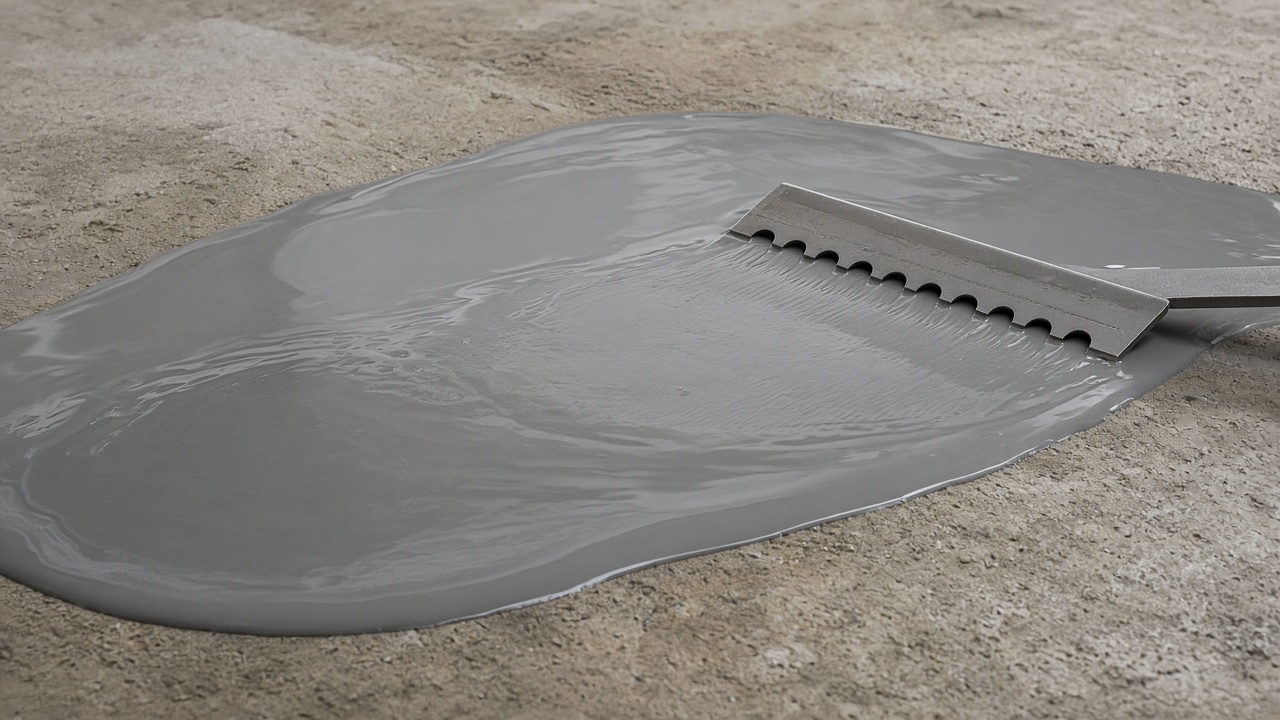
Sample 05 Self-level in progress. The rake sets the thickness. The floor finds its own level after that.
Epoxy coating
Two rolled coats over a primer, 0.3 to 0.5 mm when it is honest. It closes dust, it takes a colour, and it makes a light store or a parking aisle easier to wash. It is the charcoal chip, and it is where safety-yellow aisle lines usually live, masked into the top coat so they are not a sticker that a pallet rips off in a week.
It is the wrong sample under a loaded forklift. The film is thinner than a credit card. Turning wheels polish it, then cut it, then the slab is back. We will roll it for a mezzanine, a spare-parts cage, a showroom store that sees shoes and the odd trolley. We will say no when the brief is “the reach trucks start Monday.” Guide rate ₪98 per square metre including VAT. Feet in 10–14 hours in a summer hall, 18–28 hours when the slab is cold. Do not plan wheels on it as a wearing course.
Self-level
A filled epoxy with a low viscosity, poured and raked to a set thickness, then left to flow. Our usual industrial body is 2 mm, inside a 1.5–3 mm range. A 2 mm body is on the order of 3 to 4 kilograms of filled resin per square metre. That is a practical quantity, not a safety claim. It is why the price is not the price of paint.
This is the default for a production hall, a packing room, and a warehouse aisle with regular trucks, provided the moisture test passes and the cure board is respected. Concrete grey is the chip. Oxide pigments are possible; oxide red on this site is reserved for the cement system so the rail does not lie. Summer feet 12–16 hours, forklifts 36–48 hours. Winter feet 24–36 hours, forklifts 72 hours. Guide rate ₪189 per square metre including VAT.
Self-level hides small trowel marks. It does not hide a rocking joint or a drain that sits proud. Those are build problems, solved before the resin is mixed. In July we start at 06:30 and we stop while we can still keep a wet edge. A hot slab shortens the working time. Rushing the edge leaves a ridge you will feel with a pallet wheel for ten years.
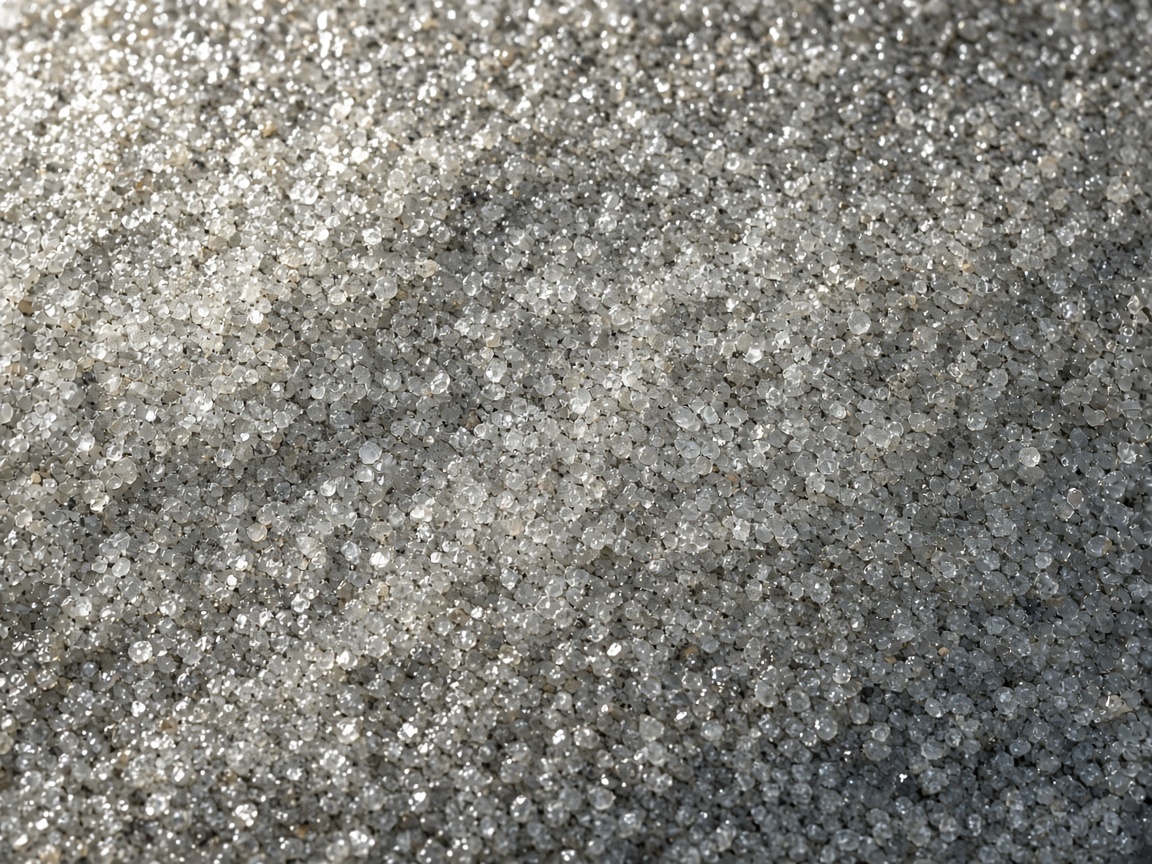
Sample 03 Quartz, close enough to see the grain. The lock coat is what makes it a floor you can wash.
Quartz broadcast
A body coat goes down, kiln-dried quartz is thrown to rejection, the excess is recovered the next day, and a lock coat ties the grain. Finished thickness is usually 4 to 6 mm. The sand chip is this system. Grip stays when the floor is damp or oily, which is why it shows up in loading aprons, wet corridors, and the edges of a kitchen back when polyurethane cement is more than the room needs.
It is slower than a self-level and it uses more material. That is the price. Guide rate ₪271 per square metre including VAT. Feet in 14–18 hours in summer and 24–40 in winter. Forklifts at 48 hours in the warm months, 72–96 when the hall is cold. A broadcast that is starved of sand looks pretty and polishes smooth. We seed to rejection on purpose. If you want a showroom sheen, this is the wrong system; take the clear top instead.
Polyurethane cement
A trowelled mortar of polyurethane and cement, 6 to 9 mm. It is the system we write for a food-prep back room, a wash bay, or anywhere the floor sees hot water, steam, or a daily chemical splash. Epoxy, even a thick epoxy, softens and blisters when hot water hits a cold film. The cement mortar is built for that shock. Oxide red is the chip we keep for it, because the floors that need it are rarely asked to look like a gallery.
It is specified for splash and wash-down when this is the system on the quote. That is a description of duty, not a certificate, and not a claim that every resin in the yard is fit for food. The safety data sheet is on the van. Guide rate ₪378 per square metre including VAT, for a 6 mm body on a sound slab. Falls, drains and coving are extra lines: coving about ₪31 per linear metre including VAT, measured on the walls, not guessed from a plan that has no scale.
Feet often in 8–12 hours, because the mortar sets faster than a decorative epoxy. We still do not release forklifts the same afternoon. If the slab is under the minimum temperature on the sheet — a January dawn in an unheated shed can be there — we do not start. Winter hold is overnight for feet and about 48 hours for wheels.
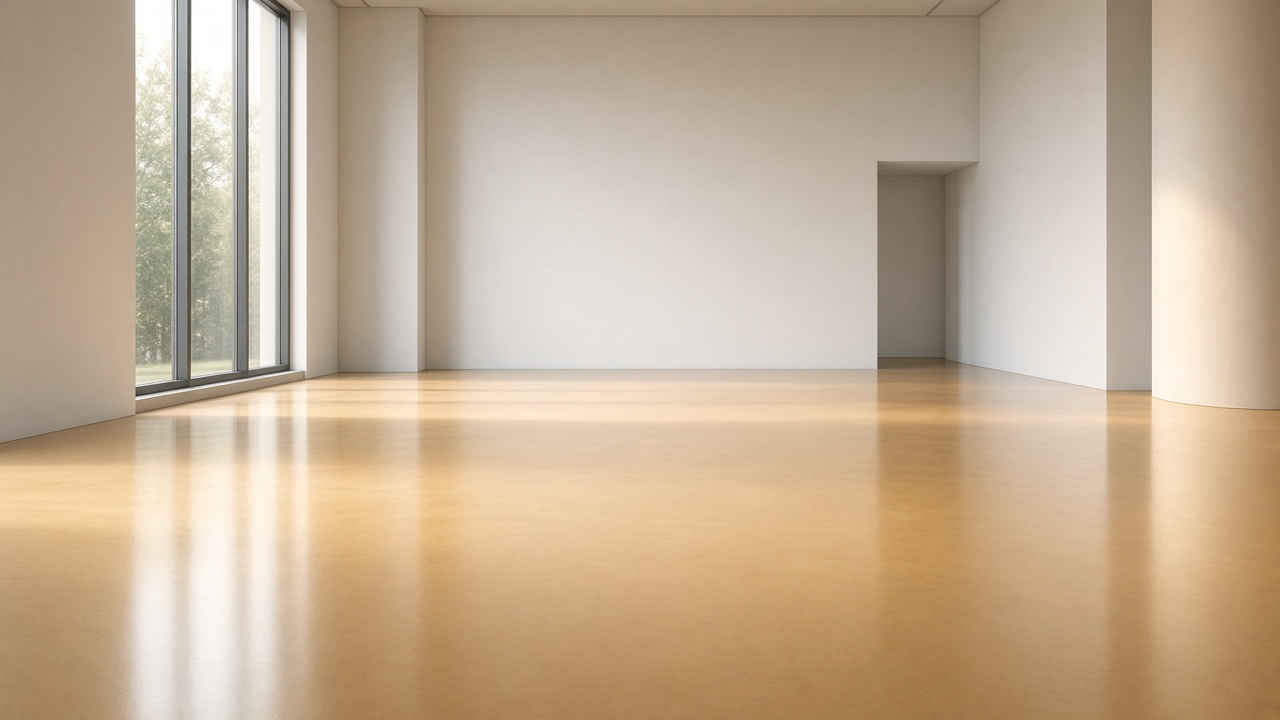
Sample 02 Amber-tinted showroom floor. The colour is in the top, not in a sticker.
Clear and amber tops
A showroom wants the self-level body and then a clear or amber-tinted top. The clear chip is this line. Dust in the hall becomes part of the floor, so the grind, the vacuum and the closed doors matter more than the pigment. Guide rate ₪214 per square metre including VAT. Trolleys after 48 hours. Not forklifts, not a loading dock, not a place where a roll-up door stands open onto a sandy yard while we pour.
UV through a west window will yellow some epoxies over years. Where the glass is large we say so, and we choose the top accordingly. We do not promise that a resin will match a fabric swatch under every lamp. Bring the chip to the room in daylight before you approve it.
Ask the plant with the area, the use of the room, and the city. A chip selection on this website does not book a crew.
One cookie remembers this choice on your browser. We do not run advertising tags. Cookies.