02
Build
The floor is made in the grind
Resin sticks to clean, open concrete. It does not stick to laitance, to forklift oil, or to a coat of dust we failed to vacuum. Most of the floors that come back to a contractor failed before the first litre was mixed.
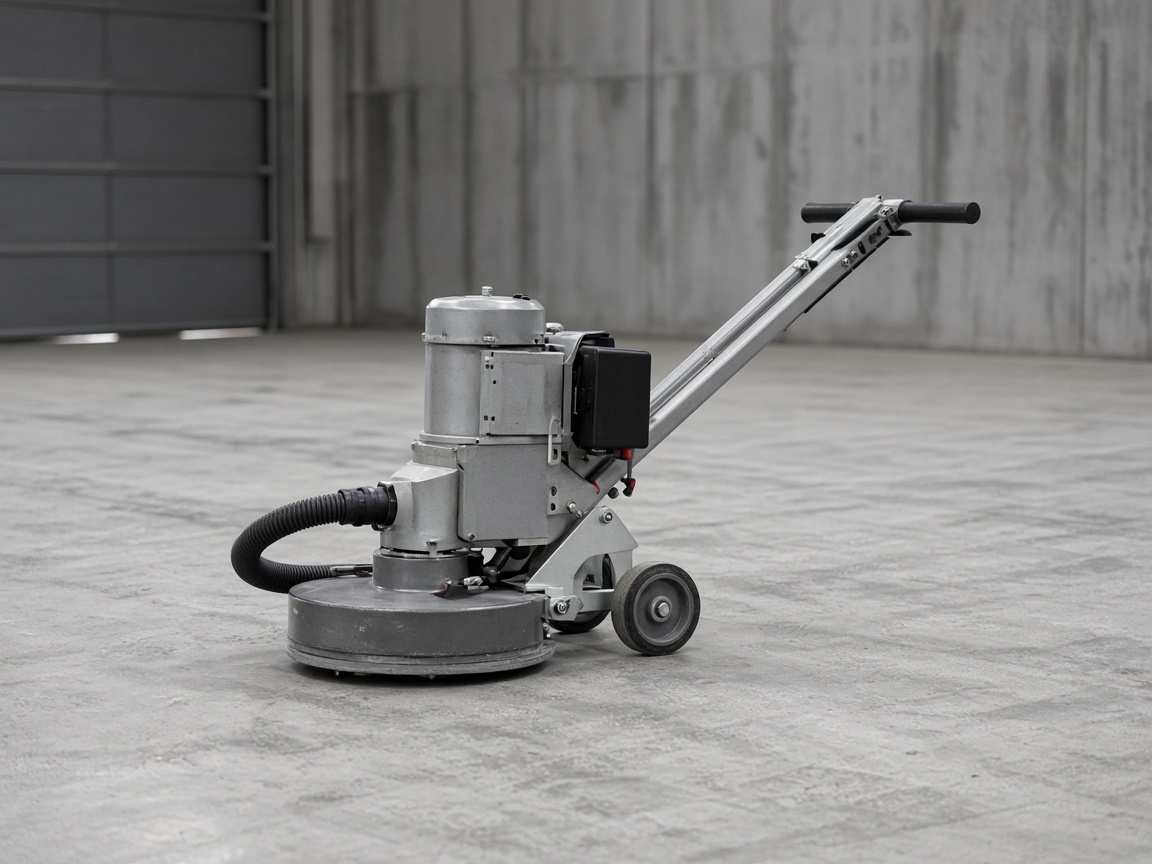
Diamond grind, not a broom
We grind with diamonds under a shroud, tied to an extractor. The profile has to be open enough for the primer to wet the paste, and even enough that a 2 mm self-level does not telegraph a ridge. A “clean and coat” quote that skips the diamonds is a different job. If that is what you were offered at half the rate, you were offered a different floor.
Old acrylic sealers, tile adhesive, and bitumen paint do not come off with a mop. If we find them, the rate changes or the day stops. Ceramic tile that sounds hollow is not a substrate. We will not bury it. A green slab, still shedding mix water, waits. Age on a drawing is not a reading.
Dust
Grinding old concrete makes a fine alkaline dust. Some of it is silica from the sand in the slab. In a live warehouse that dust is a real problem for pickers, for open product, and for the next aisle’s sensors. We do not grind while people are picking in the same aisle. We tent the bay when the racking is tight. We bag what the machine collects.
We will not give you a percentage of dust captured. Machines and rooms vary, and a percentage on a website would be a costume. The working rule is simpler: you will see some dust on a ledge, you should not see a cloud rolling into the next hall, and if you do, we stop and change the setup before we continue. Tell us if the hall packs food, pharma, or anything that cannot take a film of powder. That changes the tent, the hour, and sometimes the week.
Oil, joints, cracks
Forklift aisles in Holon sheds are often black with hydraulic oil at the turns. Oil has to be cut out, not painted over. A primer is not a degreaser. If the concrete is saturated, we grind deeper or we cut the patch out. That is visible on the day, and it is a line on the quote if it is more than an ordinary stain.
Saw-cut joints stay joints. We do not flood them with a rigid epoxy and pretend the slab will stop moving. After the body has cured we fill them with a flexible joint filler, typically ₪71–142 per linear metre including VAT, counted when we can see the grid. Cracks that are stable get routed and filled before the pour. Cracks that are still moving get a decision: bridge them in a way the system allows, or stop and talk to whoever owns the structure. A resin floor is not a structural repair.
Ordinary crack routing on a sound slab sits inside the guide rate. A bay with spalled arrises, a rocking panel, or a drain that has collapsed does not. We would rather stop at the grind and price the repair than discover it under wet resin at noon.
The night before
The bay has to be empty. Racking legs can stay; pallets cannot. We need a clear path from the door to the bay for the grinder and the mixer, a power point that can take the machines, and water for the cleanup. Someone on your side needs to be able to kill the sprinklers’ test cycle and to keep the roll-up door shut once we are pouring. A door left open onto a sandy yard is how a showroom top gets a grit rash.
In a live warehouse the usual pattern is one aisle after the shift. Sunday to Thursday we will start early, 06:30, or stay into the night. Friday we finish by early afternoon. Saturday the plant is closed: we do not grind and we do not pour. If your only window is Saturday, we are the wrong yard.
Access, the moisture test and the cure window are also terms, not slogans. The order of work on a normal bay is: clear, moisture check, grind, vacuum, repairs, primer, body, and then the board on the upright. Skip a step and the pretty colour will not save it.